Today's post is a guest-post from my good friend Scott Essman at Universal Studios. Scott has been carrying the classic monster torch for years, fighting the good fight to keep these ghouls alive for the next generation of monster kids. His passion for these films is evident in his writing - check it out, and remember - the Universal Monsters will be released on Blu-ray on Oct. 2, 2012!!
They’re Still Alive – The Universal Classic Monsters
By Scott Essman
It’s a quiet dusty morning in the summer of 1916 and all but a small eastern region of the San Fernando Valley is largely undeveloped, to say nothing of unpopulated. For the past year, inside of an unassuming front gate just over the hill from Los Angeles proper, two men are trying to forge their path in the fledgling motion picture business: Lon Chaney and Jack Pierce. Nascent actors Chaney, 33, and Pierce, 27, were completely unknown, but each had an angle; they could both work magic out of a simple makeup case, fully transforming their faces and even parts of their bodies to put themselves into a better position to be cast in a role. They often worked out of Universal’s “bullpen,” getting chosen to play Indians, cowboys, pirates, or virtually any part called for in the roundup of silent shorts at the time. Little did these men know that, less than a decade later, they would initiate a cinematic movement that would change history.
Of course, the place was Universal Pictures, which had been founded by Carl Laemmle, a former midwestern haberdasher who consolidated several distribution enterprises into one operation in 1912, then claimed the named land, opening Universal City in 1915. Surely, Chaney and Pierce engaged in very different career trajectories, but both became key players in the boom of both Universal and the American monster movie. With Universal now celebrating its 100th anniversary, those early years are an essential chapter in the studio’s history, the days when the brand surged to new heights at the box office by taking giddy moviegoers into the dungeon depths of their collective imagination. The magic of those characters, films, actors and filmmakers has never really left us, ever since Dr. Frankenstein famously bellowed, "It's alive!"
Even after leaving Universal to become a freelance actor in 1918, Chaney returned to make the smash hit “The Hunchback of Notre Dame” at Universal in 1923. Although the grotesque titular character was a makeup landmark, “Hunchback” was never considered a horror film and Quasimodo not a horror character, that honor not bestowed upon Chaney until his next Universal film, made as a loaner from the newly formed MGM Studios. “The Phantom of the Opera” in 1925 was another unbridled hit, with Chaney’s unmasking as the named Phantom resonating as an all-time classic moment in cinema.
Taylor White, publisher of “The Man of a Thousand Faces,” a book of Bill Nelson’s illustrations of Chaney’s vast and varied characters, noted why the Phantom has resonated among Universal’s greatest characters. “Chaney's Phantom continues to be an indelible character for two reasons,” White said. “On the exterior, Chaney's unforgettable makeup is still terrifying and obviously set the standard long before any other classic monster. And second, Chaney's skills as an actor managed to convey both the physical pain and emotional wrenching of a shattered heart in losing his beloved Christine.”

Thus was set in motion the trademark for a studio which was nonetheless long regarded a second-tier operation. Speculation that Chaney would have returned to Universal for additional horror films in the sound era has been widely disputed. His death in 1930 ended any such possibilities, but by then, new faces in the Universal upper echelons set the studio on a new course within horror. Carl Laemmle Jr. had been promoted to the head of production by his father as a 21st birthday present in 1927, which left him running Universal City’s operations and personally selecting such projects as “The Man Who Laughs,” a late silent hit, and two early 1930s films which to this day define the studio.
“Dracula” and “Frankenstein” were both released in 1931, only nine months apart, and set new standards in many moviemaking categories. “Dracula” is often criticized for its slow pacing and stagy underpinnings, but Lugosi’s performance, perfected on Broadway in the late 1920s, remains indelible and haunting to this day. Surely, Jack Pierce’s work as makeup department head of Universal at the time cannot be understated, though he did not have the chance to create anything elaborate for Béla Lugosi as Count Dracula, the actor putting the kibosh on Chaney-esque makeup concepts. Pierce reserved the complete makeover for Boris Karloff on “Frankenstein,” planned just a few months after “Dracula’s” success mandated that the studio follow it up as soon as possible. When director James Whale was brought onto the former picture, Pierce had the license to test different makeups which ultimately required both Laemmle Jr. and Whale’s approval. As Alec Gillis, a makeup and creature master for over 25 years stated, “‘Frankenstein’ was the perfect storm of Jack Pierce at the top of his game, with makeup techniques refined enough but not too much, and Boris Karloff at his most cadaverous and brilliant.”

Surely, Karloff’s metamorphosis from barely regarded character actor to international superstar in “Frankenstein” is due in large part to Pierce’s techniques and Whale’s direction, as director John Landis (“An American Werewolf in London”) explained. “Jack Pierce's makeup combined with Boris Karloff's remarkable performance make the Frankenstein Monster in James Whale's “Frankenstein” the most memorable and iconic of the Universal monsters,” Landis said. “Karloff makes the Monster both vulnerable and sympathetic and yet powerful and terrifying when the moment calls for it.”
But just as compelling as Whale’s direction and Pierce’s makeup magic on “Frankenstein” are less heralded elements, such as costume design, art direction and cinematography. Vera West was Pierce’s counterpart as Universal’s longtime head of costume design and contributed the gothic period designs in the film while Charles D. Hall, the studio’s head art director, built the timeless sets for the film, including the castle-bound laboratory set for the opening half, most vividly seen during the climactic “creation” sequence. Director of photography Arthur Edeson undershoots Karloff’s creature in nearly every moment, an approach that has influenced legions of films, both within the horror genre and otherwise. In one more obscure example, witness how Edeson shoots Karloff’s first entry as the Monster as he turns around in the doorway to the castle interior. Edeson frames the creature in three progressively closer shots, a series mirrored in James Cameron’s “The Terminator.” Watch as the Terminator endoskeleton emerges from the fiery truck explosion at the end of the film; Cameron and cinematographer Adam Greenberg more than quote Edeson’s shots – they are nearly identical.
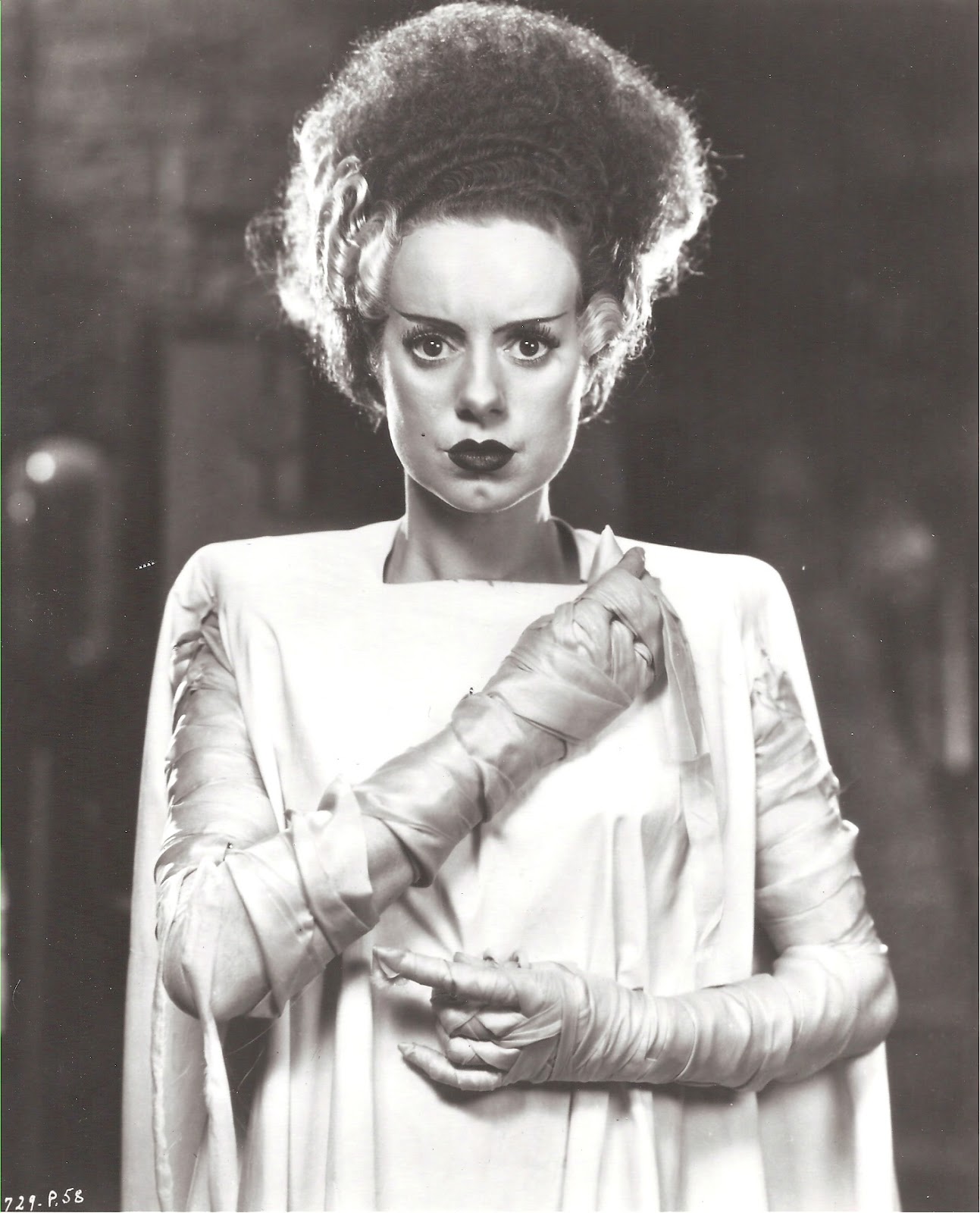
During the Laemmle era, Universal capitalized on their triumphant year by following 1931 with an active horror output in 1932-1936 before the founding family had to sell the studio due to mid-Great Depression financial crises. From 1932’s “The Mummy,” another masterpiece of slow-building terror with an unprecedented Pierce makeup and Karloff characterization, to Whale’s “The Invisible Man” introducing the striking persona of Claude Rains, to several Karloff-Lugosi pairings, the studio produced many unforgettable films at the time. Arguably the crown jewel of the mid-1930s Universal output is 1935’s “The Bride of Frankenstein,” which many consider the finest of the films in many respects. Elsa Lanchester as the named Bride created a remarkable vision of ghoulish beauty, even more impressive when considering she is only onscreen as the wordless creation a few scant minutes at the end of the film. Karloff, given the chance to speak as the Monster, offers one of his best screen performances in “Bride,” and in tandem with the first “Frankenstein” film, makes the character recognizable to most any age audience member of any era. Karloff historian Ron MacCloskey elaborated on the timeless nature of Karloff’s appearance. “The look of the Monster, with the flat head, scars and electrodes on the neck, is seen every Halloween,” said MacCloskey. “Even the movements of the Monster—stiff legs, arms outstretched—are all immediately identifiable.”

Alas, with the Laemmles out, regime change dictated a shift in philosophy at the studio in the late 1930s, and for a time, it seemed that the Universal monster film had indeed died. But audience demand necessitated a quickly-arranged sequel, and at the end of the decade, “Son of Frankenstein” debuted. Featuring Karloff in his final turn as the Monster and Lugosi, in one of his best performances as the wretch, Ygor, the third “Frankenstein” film might not have had the facility for fascinating audiences as the first two films, but it ushered in a slew of additional Universal genre films – albeit many sequels – in the early-to-mid 1940s.
Among the horde of genre films at Universal during a time of rotating studio heads, only 1941’s “The Wolf Man” featured a monster that resonated as strongly for as long a period of time as the characters in the films of the 1930s. Played to perfection by Lon Chaney Jr., the Wolf Man character was not the first lycanthrope on screen and might not have amazed audiences as significantly as the many elaborate werewolves to come, but the film and character continue to fascinate genre fans. Creature creator John Rosengrant (“Jurassic Park”) explained the longevity of the singular project. “The basic story is timeless as it parallels the storylines of the Greek tragedies,” he said. “A person is suffering by the whim of the Gods through no fault of his own.”
When Universal merged with International Pictures just after World War II ended, directions were again altered, seemingly for good, which might have relegated “House of Frankenstein” and “House of Dracula,” the two so-called “monster rallies,” as the final Universal horrors in 1944 and 1945, respectively. Yet, there was life still twitching as several characters were brought back – without Jack Pierce, Vera West, or special visual effects expert John P. Fulton – for “Abbott and Costello Meet Frankenstein” in 1948. Though that monster-comedy film was an unqualified hit, it did not spurn a return to heavy genre output at Universal-International.

Instead, the 1950s ushered in a slate of science-fiction-based films, with one last monster picture coming to fruition when it debuted in 1954. “The Creature From the Black Lagoon” was considered in as high regard as its big brothers and sisters from some 20+ years beforehand though decidedly in a modernized technological vein. However, the amphibious Gill-Man shared the tragic path of the earlier Universal monsters, and represented yet another instantly iconic visage as denoted by veteran creature designer and performer Tom Woodruff, Jr.. “There is a blankness to its expression, fitting for its primeval aquatic origins,” he said. “And there is a simplicity to the execution of the build of the suit that resonates the ‘less is more’ school of design.” When the third “Creature” film unspooled in 1958, it was widely accepted as the last breath of the Universal cycle.
Magazines such as Famous Monsters of Filmland helped keep the Universal monsters alive for new generations in the 1960s and 1970s through publishing detailed accounts of making of the films and rarely seen photographs. The films also lived on through broadcasts on syndicated television stations nationwide in a time before home video, which has now obviously brought the films and characters to a new level for contemporary fans. Veteran actor and monster collector Daniel Roebuck connected such new fans to the ones who first viewed the films in a theatrical setting. “Although not scary to the modern audiences, the pathos and tragic suffering of so many of these characters can't help but touch the viewer,” he observed.
Certainly, the Universal monsters have never truly dipped in their popularity and are still foremost among genre fans despite their notable age in a time of erstwhile short attention spans. Oscar-winning makeup artist William Corso (“Lemony Snicket’s A Series of Unfortunate Events”) summarized the effect that the films have had on numerous filmmakers working today, including not only makeup people, but visual effects artists, writers, and directors. “Universal’s stable of monsters inspired me and countless generations to enter the fields of art and film,” he said. “Not only can they be counted as some of the most iconic characters in film history, but also as significant works in the history of art, as much as any of the old masters gave us.”

In the end, audiences continually return to the Universal monsters for reasons that cannot often be easily explained. Without question, Hollywood has churned out more visceral, explicit, and even frightening films in most every decade since the originals. So why are the classic monsters a constant presence in merchandise collections, video libraries, and televised and theatrical revivals, both during Halloween season and otherwise? Fred Dekker, co-writer and director of “The Monster Squad,” the 1987 homage to the original characters, offered one provocative answer. “What's timeless to me about the Universal monsters is that on one level, they're not really monsters at all; they're outcasts,” Dekker said, “and in most cases, not by choice. Dracula has a disease, the Wolf Man an affliction. The Mummy was killed and resurrected against his will, and Frankenstein's Monster never asked to be born. The Gill-Man is out of his time. So on one level, they're these iconic boogey men who scare us—but at the same time, they appeal to that part of us that feels like an outsider, a weirdo, like someone who doesn't quite fit in. I think we relate to them on that level, even if it's subconsciously.”
Scott Essman has written extensively about Jack Pierce and the Universal Classic Monsters since 1996. He can be reached at scottessman@yahoo.com.




.jpeg)

