The 12th annual Rondo Awards are now under way, recognizing the best in classic monster research - have you voted yet? Among the nominees for this year in the Category of
BEST ARTICLE (Category 13) is yours truly with an article debating the origin of the Frankenstein Monster's makeup in the 1931 Universal movie. What's that, you haven't read it yet? Well, here's your chance - the entire article posted below, reprinted from the Scary Monsters article in issue #85.
After you read it, why not drop an email to Dave Colton at
taraco@aol.com and tell him you want to vote for Larry Underwood (aka Dr Gangrene) for Best Article
- And while you're at it, why not vote for Doc Gangrene for Best Horror Host (category 24), - and Best Blog (category 19) and Best Magazine Column (category 16). Remember to include your name for the vote to count. See the entire ballot at:
www.rondoaward.com
I appreciate your support - now on to the article!!
________________________________________________________
Credit Where Credit is Grue: Jack Pierce, Frankendesigner
by Larry W. Underwood
Castle Of Frankenstein: How much of the monster’s appearance came from Jack Pierce?
KARLOFF: All of it…
In his essay "Uncanny Bodies: The Coming of Sound Film and the Origins of the Horror Genre" author Robert Spadoni describes the Monster’s look as “a face whose iconic power rivals that of the Mona Lisa and whose ‘unforgettable’ status registered instantly at the moment of its first appearance.” Jack Pierce, head of Universal’s makeup department, is widely recognized as the man responsible for creating the look of the Monster, as well as that of many of Universal’s most recognized and beloved characters. However, in recent years there appears to be some question of just who was responsible for the design of this iconic look that Pierce implemented, and a concerted effort seems to have been underway to shift the credit away from Pierce and into the hands of Frankenstein director James Whale.
On June 16th, 1931 Universal began filming a screen test for Frankenstein. Robert Florey directed this shoot with actor Bela Lugosi playing the role of Frankenstein's Monster. Just exactly what the look of the Monster was at that time has been the subject of some debate over the years as the test footage, reportedly two entire reels worth, is now lost. The fact of the matter, however, is that the test footage with Lugosi as the Frankenstein monster was deemed unsatisfactory and by June 29th of that year producer Carl Laemmle Jr. had replaced Florey with up-and-coming British director James Whale. Final filming began on August 24th, 1931, with actor Boris Karloff wearing the now famous Frankenstein makeup. The question is did Jack P. Pierce design and implement this makeup himself, or was he following previously created sketches done by director Whale?
In the book THE MONSTER SHOW (1998), author David Skal builds a case in favor of Whale, saying, “For one thing, the makeup (like that of the monster’s bride four years later, another Whale/Pierce collaboration) is obviously influenced by modernist trends in the theater and visual arts – notably expressionism, constructivism, and the machine aesthetic generally.” I take odds with this description - to claim that the makeup design of the monster is a product of modern art trends is a stretch, whether it is Cubism, Expressionism, or the Bauhaus (as Skal claimed in the original 1993 version of his book) or any other “ism” you care to attribute. I take particular exception with the comparison to Expressionism, an avant-garde art movement that emphasizes the artist’s subjective interpretation over a realistic depiction of the subject matter. Think Vincent Van Gogh’s “Starry Night” or Edvard Munch’s “The Scream,” stylistic, emotional interpretations of realistic subject matter. That sort of creative imagining is far removed from--if not a complete opposite approach to--designing a makeup that was meant to be realistically believable.
Skal, attempting to drive home his point, argues that “Though he was indisputably a gifted technician, there is no record that Pierce was influenced by or had any particular interest in modern art," and perhaps this is true – however, Jack Pierce, far from being influenced by trends in art, approached the design as scientifically and clinically as possible. In a January, 1939 interview with the New York Times, Pierce explained, “I didn’t depend on my imagination. I did three months of research in anatomy, surgery, criminology, ancient and modern burial customs, and electrodynamics. My anatomical studies taught me that there are six ways a surgeon can cut the skull in order to take out or put in a brain. I figured that Frankenstein, who was a scientist but no practicing surgeon, would take the simplest surgical way. He would cut the top of the skull off straight across like a pot lid, hinge it, pop the brain in, and then clamp it on tight. That’s the reason I decided to make the Monster’s head square and flat like a shoe box and dig that big scar across his forehead with the metal clamps holding it together”
In an interview with MONSTER MANIA magazine in October, 1966 Pierce explained that he made hundreds of sketches and models while designing the Monster and that he made a life-sized casting. Pierce brought that casting with him when he made a TV appearance in 1962 on MILLION DOLLAR MOVIE, hosted by Wayne Thomas on KHJ-TV in Hollywood. In attendance that day was fan favorite Bob Burns, who provided the audio of this appearance for MONSTERS FROM THE VAULT magazine #14 (he had asked a friend to stay home and record the audio on a reel-to-reel recorder as it aired, and still has that tape to this day). This casting was made off of a clay head of the monster featuring a rough version of the design, an early draft of the finished form. The following is a portion of the interview from that appearance:
WAYNE THOMAS: There you have the original head, sculpted 32 years ago by Jack Pierce, back in 1930, for Frankenstein…How did it come about? How did they decide to make the movie and how did they happen to have the Monster look the way it does?
PIERCE: Well, Junior Laemmle brought me the book, and I read the book three times. And from that I did a lot of research work…
WAYNE THOMAS: Now, when you worked this head out, made it out of clay and put the hair on it and took it into his (Carl Laemmle Jr.) office, then what happened? What did he say to you?
PIERCE: Well he was very much surprised. “You mean to tell me that you can do this on [a] human being?” I said, “Positively.” So he says, “All right, we will go the limit.” And from there on, the story was written, continuity was written, and then we went to work.
I asked Bob Burns about this casting, and here’s what he said:
“Jack originally made a mold off of a clay head of Karloff, but didn’t take that mold with him, only the casting of the head made from the mold. This casting was made out of wax very much like what was made for wax museums. I saw it up close, and it also looked like it had possibly been dropped a few times as there were some dents in it. ”
In the book OF GODS AND MONSTERS (1999) author John T. Soister mentions this casting, “Jack Pierce spent countless hours on anatomical research, pencil sketches, and puttering with putty on the Karloff life-mask that he had fashioned.”
Directorial duties for Frankenstein were reassigned to James Whale, who began forming his own ideas for his particular version of the Shelley novel. In a letter to Colin Clive (written before filming began) Whale explained his intentions for the upcoming film: “I want the picture to be a very modern, materialistic treatment of this medieval story--something of 'Doctor Caligari,' something of Edgar Allan Poe, and of course a good deal of us.” The influence of Caligari is seen throughout the film, most notable in the set designs, with its sharp lines and exaggerated angles. In the article "Universal's Horror Tradition" from AMERICAN CINEMATOGRAPHY (April 1987) Brian Taves notes that Whale "kept most of the expressionistic set design derived from the sketches Florey and [Charles D.] Hall collaborated on." It is much more accurate therefore to say Whale drew influence from Expressionist films rather than modern art trends, as Skal suggested, as Whale lifted heavily from Frankenstein’s German predecessors. This influence shows in the acting, direction, and even lack of music. Robert Spadoni describes Frankenstein's "self-conscious indebtedness to The Cabinet of Dr. Caligari.” He writes, “Aspects of Frankenstein that show this influence include the artificial-looking sets and the narrative.” Even Skal admits Whale “studied the film in preparation for Frankenstein.”
Whale chose fellow British actor Boris Karloff for the role of the Monster, possibly at the suggestion of his longtime companion David Lewis. In a New York Times interview from December, 1931 Whale said, "Boris Karloff's face has always fascinated me, and I made drawings of his head, added sharp, bony ridges where I imagined the skull might have been joined. His physique was weaker than I could wish, but the queer, penetrating personality of his I felt was more important than his shape, which could easily be altered. “
The first sentence from the Whale quote in the preceding paragraph has been the entire genesis of the controversy of who deserves credit for the Monster’s look. The claim that Whale made sketches with the bony ridges seems believable, as he was an accomplished artist; however none of his sketches still exist to verify this, and even if they did, that certainly does not mean they existed before or were the impetus for Pierce's design. The closest thing to an existing sketch by Whale is one from a 1920 London play showing a character walking in a position similar to the Monster’s stiff-limbed walk. Certainly nothing in that design implies anything resembling the Monster's makeup design (it has, however, been surmised that perhaps Whale suggested that walk to Karloff), and if anything it contributed more to the Monster’s COSTUME design, with the similar shortened sleeves.
At this point I want to take a moment to trace exactly where the notion that Whale designed the look of the Monster originated. The quote from the Dec. 1931 New York Times interview was often mentioned in early books and articles, yet credit for the Monster’s design was still attributed primarily to Pierce. As John Brosnan wrote in 1976 in THE HORROR PEOPLE: “Whale had been fascinated by the shape of Karloff’s head and face. Karloff’s physique wasn’t really suitable for the Monster but Whale decided it could be easily altered with padding. The man responsible for turning Karloff into the Monster was make-up expert Jack Pierce.”
The first mention I’ve found of any sort along those lines was from James Curtis in his 1982 book JAMES WHALE. He writes: “Whale’s pencil sketches were used by Jack Pierce as a guide for moving in a new direction from the monster he fashioned for the Florey test.” Suddenly Whale was being given credit for inspiring Pierce’s design. Where Curtis got this piece of information is questionable, as there is no reference material to support that theory, and it seems to be mere conjecture on Curtis’ part.
David Skal was the next to pick up on this and report it as fact. In the original version of his book, THE MONSTER SHOW (1993) he writes, “Whale thought Karloff’s face had interesting possibilities; an amateur painter himself, the director sketched the actor, experimentally exaggerating the bony ridges of Karloff’s head. He showed his ideas to Jack P. Pierce, head of Universal’s makeup department since 1926.” Mr. Skal goes on not only to give reasons supporting the theory of Whale as originator of the design but to take a swipe at Pierce in the process, “Pierce was considered a genius by those who worked with him, although perhaps an egotistical one; he never publically acknowledged Whale’s part in developing the Frankenstein makeup.” James Curtis’ JAMES WHALE is listed as one of the books Skal used for reference.
In 1995 Christopher Bram would take this theory up a notch in his book FATHER OF FRANKENSTEIN, a piece of fiction based on the life of James Whale. In it Whale is talking to a young reporter about Frankenstein:
Reporter: “Who came up with his makeup and look?”
Whale: “My idea. Muchly. My sketches. Big heavy brow. Head flat on top so they could take out the old brain and put in the new, like tinned beef.”
Whale is now suddenly THE person responsible for the design of the Monster. Not merely the horned ridges Whale initially mentioned but now also the brow, flat top, everything iconic about the look of the Monster derives from his sketches in this story. While FATHER OF FRANKENSTEIN is a work of fiction, this exchange is no less important as it contributed to the proliferation of the Whale-as-originator theory. (To his credit, Bram writes in the Author’s note at the end of the book, “THIS IS A WORK OF FICTION ABOUT A REAL MAN’S LIFE. I’VE KEPT TO the general facts of James Whale’s life but have taken liberties elsewhere.”)
In 1997 director Bill Condon wrote a screenplay based on the Christopher Bram novel. Titled GODS AND MONSTERS it not only used the same scene from the book but also added a scene showing an actual drawing of the Monster by Whale to further cement the theory once and for all that Whale designed this look and Pierce was the mere craftsman carrying out his design.
1998 was a banner year for the building of the Whale mythos as three new works hit the market almost simultaneously. James Curtis put out a new expanded version of his book entitled JAMES WHALE, A NEW WORLD OF GODS AND MONSTERS. David J. Skal put out a new book entitled SCREAMS OF REASON, MAD SCIENCE AND MODERN CULTURE and the film version of GODS AND MONSTERS directed by Bill Condon hit the big screen nationwide. Skal was on set for the filming of Gods and Monsters for much of the shoot and produced, wrote, and directed a video documentary called "The World of Gods and Monsters: A Journey with James Whale." In SCREAMS OF REASON Skal now proposes, “Although Jack Pierce has been given the lion’s share of credit for the monster’s appearance, there are indications that Whale himself was largely responsible.” By this point Whale has become largely responsible, yet there is no evidence of this, only Skal's and James Curtis’ suppositions.
Through repetition this became the accepted mantra for the development of the Monster’s design. In the 2007 book UNIVERSAL HORRORS, THE STUDIO'S CLASSIC FILMS 1931-1946 (revised edition), by authors Weaver, Brunas and Brunas, they write: "The Monster’s makeup design was once assumed to be wholly the creation of Jack Pierce, but in more recent times Whale’s contribution has been recognized. That Whale’s sketches of the creature’s design jibes comfortably with the finished product can’t be denied.” In the original (1990) edition of UNIVERSAL HORRORS the authors made no mention of Whale as the originator of the design, but are now touting it as fact in the revised edition. None of Whale’s sketches survive, so exactly what the authors are referring to is a mystery.
In issue #9 of CASTLE OF FRANKENSTEIN editor Calvin Beck interviewed Boris Karloff and addressed the question of Pierce’s involvement with the monster’s makeup design directly:
COF: "How much of the monster’s appearance came from Jack Pierce?"
KARLOFF: "All of it… except for one small detail. It was effective because he experimented and tried all sorts of things. Finally, when we were in the last stages and getting down to what it would be, my eyes seemed too normal and alive and natural for a thing that had only just been put together and born, so to speak. I said, “Let’s see if we can do something about it”… and I said, “Let’s put some putty on the lids.” He put some putty on and shaped it so that the lids were the same… and that was it.”
This came directly from Boris Karloff himself, who certainly would know as he and Pierce worked together for three weeks developing the makeup for a test shoot. Karloff said, “After Whale asked me to make a test for the Monster, the first thing I did was go to Jack Pierce, the head makeup man at Universal. Jack was nothing short of a genius, besides being a lovely man. He was also in the inside of the studio, knew what the score was, and was in a position to stall the test. So at the end of the day’s work on Graft I would stay, and he would stay, and nightly he worked on the makeup until we felt it was ready. People in production were constantly calling and saying ‘Aren’t you ready yet?’ And we would answer, ‘No – we’re not ready yet’… I have to give him full marks for realizing the importance of what, ultimately, was a work of art." Mae Clarke, who appeared in the film in the role of Elizabeth, recalled: "Jack Pierce was a genius. I remember him working with the still man, taking pictures of each step as the make-up was applied.”
This is the way the make-up most likely developed, bit by bit, with Pierce experimenting and documenting every step of the way, making changes, taking pictures, and so on. In an interview with FILMS AND FILMING magazine from 1957 (later reprinted in CASTLE OF FRANKENSTEIN #14 in 1959) Karloff said, “I was given a test and got the part although the make-up was not at that time created. Jack Pierce, the chief make-up artist at Universal, and I, worked three hours almost every evening for three weeks creating the make-up. Finally James Whale, who directed FRANKENSTEIN, saw the test and was overjoyed.”
In an interview from a Spanish newspaper Pierce explained more about this process - “It’s impossible to count the number of hours he was here in this chair serving as a living model for diverse experiments that we photographed, to immediately change or discard according to the opinion of Mr. Laemmle, Mr. Whale, and other studio bosses.”
A famous photograph survives of Karloff with pronounced “horns” or ridges on his forehead. These are no doubt the same ridges that Whale mentioned sketching. In the October 1966 MONSTER MANIA interview Pierce was asked about this:
MM: We’ve seen a still from Frankenstein showing Karloff wearing slightly different make-up. He had two fleshy folds on his forehead with what looked like large staples holding them in place. Was this a test?
PIERCE: That was an idea of the director, James Whale. We later made a compromise.
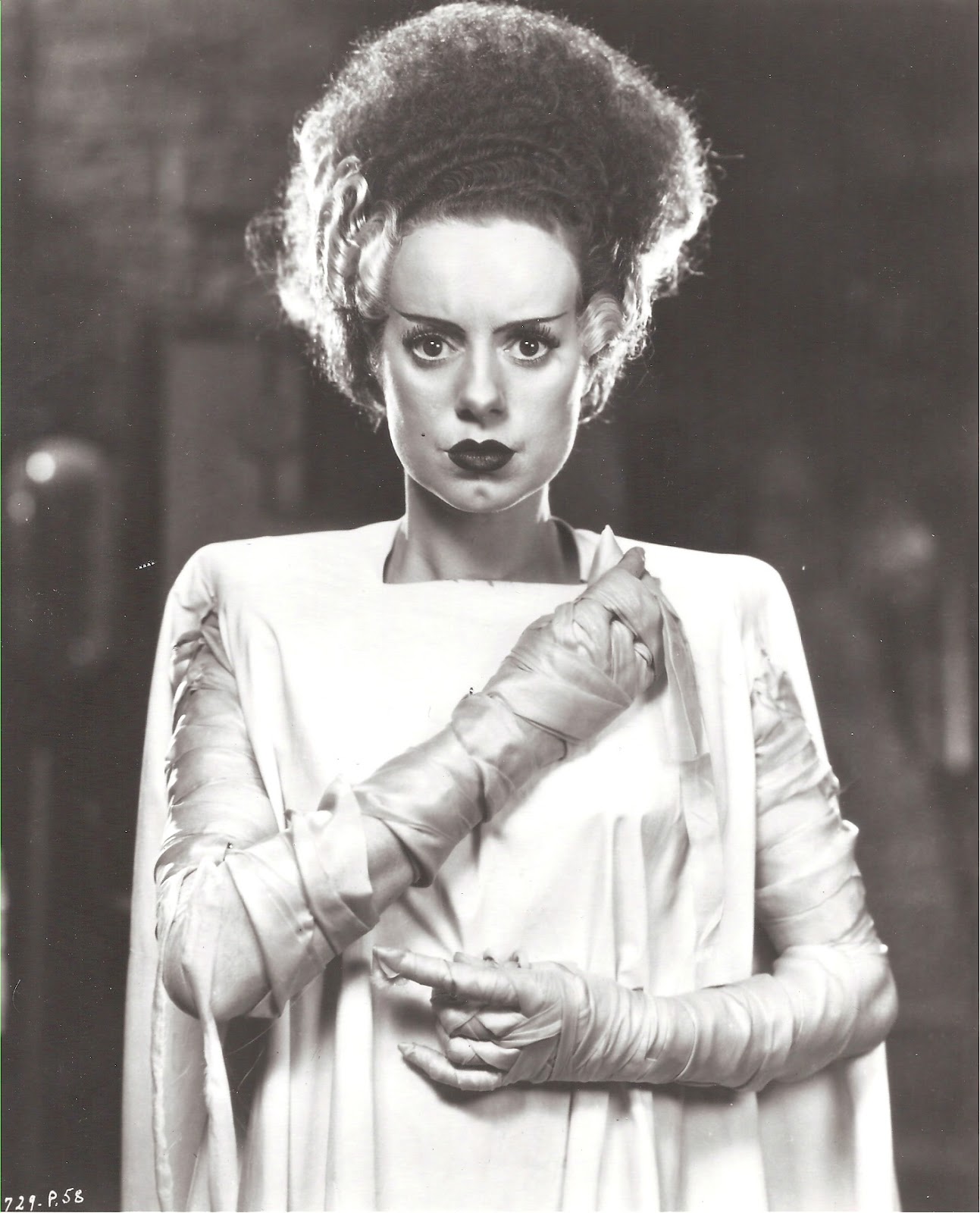
That compromise, no doubt, was the metal clamps just visible through the hairline in the first film and quite prominent in Bride of Frankenstein. The fleshy organic horns hearken back to Skal’s Expressionist theory, a subjective interpretation and addition by Whale, a fine artist, and not one that Pierce would have conceived or approved of. The metal clamps scream of the practical approach of Pierce – Dr. Frankenstein would simply clamp the skull together with metal to hold it in place. Makes sense. In the end, practical won out over fantastic and the horns were dropped in favor of the more efficient clamp design.
Paul Jensen made mention of the Whale drawings in his 1996 book THE MEN WHO MADE THE MONSTERS. He said, “In 1931, Whale mentioned drawing Boris Karloff’s features and contributing to the makeup design. True, he often did provide technicians with sketches to guide their work, but the Monster’s basic appearance probably existed before Whale became involved.”
In fact, there is even some debate as to exactly how early the basic Pierce design developed. In the famous lost test footage Robert Florey and cameraman Paul Ivano both swore years later that Lugosi wore an early, rough version of the final famous design.
Here’s Jensen on the topic:
“According to both Florey and Paul Ivano, Jack Pierce’s makeup for Lugosi in the test was similar to that eventually used for Karloff, and one page of Florey’s script contains a rough sketch of the Monster’s now familiar square-skulled head, with a notation that Pierce should add bolts to the neck.”
Perhaps there is some truth to that story. Remember, Whale was stepping into a production that was already well under way. Just as he used many elements of set designs that already existed, perhaps the Monster's look evolved from some preliminary work that Pierce had already conceived.
In 1970 word surfaced that a print of the lost Lugosi test footage filmed by Florey had surfaced and was for sale. This information was reported in several places and turned out to be a hoax - however, one of the publications where it was reported was a French magazine called Midi-Minuit Fantastique, issue #23. In it, along with the hoax ad, was an article that included a letter from Robert Florey to the editor of that magazine, Jean-Claude Romer. Apparently the two had already corresponded about the appearance of the Monster in the Lugosi test footage, and Romer included it as it pertained to this ad, which he believed (or hoped) was sincere.
In this letter Florey discusses this test footage, and in particular the look of the Monster:
"As to the appearance of the Monster played by Bela Lugosi, Robert Florey gives us his personal and categorical precisions. ‘It was on the set of DRACULA that my cameraman, Paul Ivano, and myself shot approximately two and a half reels (1000 feet, or about 300 meters per magazine) of test footage with Bela Lugosi at Universal Studios for Carl Laemmle Jr. in 1931, being several sequences featuring Lugosi, Edward Van Sloan and, I think, Dwight Frye, on a set by Charles Hall. The makeup worn by Bela Lugosi was created and designed by Jack Pierce, head makeup artist at the Studio, that is to say EXACTLY THE SAME as that worn by Boris Karloff and the other Frankensteins that followed. There was no difference WHATSOEVER between the makeup on Lugosi or Karloff. I have no idea where Jack Pierce is working nowadays, but a few years ago, appearing on television, he showed drawings he had executed for the character BEFORE the tests filmed with Lugosi. Those drawings never changed. Those who claim without having been present at the Studio at that time — that the makeups were different are wrong."
This is very interesting and quite contradictory to what Karloff claimed, that the makeup didn’t exist when he and Pierce began working together. Perhaps the truth lies somewhere in the middle, and the Lugosi makeup wasn’t quite “EXACTLY THE SAME” as Florey remembered it, but Pierce used elements of it for the final Karloff design. In my opinion, however, the bulk of the look of the Monster most likely evolved mainly from those three weeks of intensive experimentation by Pierce and Karloff.
Here is Pierce’s explanation for the now iconic bolts on the side of Karloff’s neck mentioned in the Florey script:
“Those two metal studs sticking out at the sides of the monster’s neck have puzzled folks to no end, so I’d better explain them. They are inlets for electricity – plugs such as we use for lamps or flatirons. Remember, the monster is an electrical gadget. Lightning is his life force…”
Again, another practical explanation for the addition of a design element. To attribute it to some “machine aesthetic” makes a nice footnote now, 80 years later, but the truth of the matter is it was designed with little of that in mind.
The test reel was filmed with Karloff in the now famous makeup and was a success with the Universal brass. As Gregory Mank wrote in IT’S ALIVE, THE CLASSIC CINEMA SAGA OF FRANKENSTEIN: “Junior Laemmle was amazed. Awed by the makeup, the producer also noted what Pierce had so wisely allowed: Karloff’s gaunt, sensitive face was free for the play of emotions.”
I asked Bob Burns about the theory of Whale originating the design of the Monster. Here is what he said:
“Pierce did create the makeup for Boris in FRANKENSTEIN. I've heard this story before that it was Whale's design - he didn't know beans about makeup. I talked to Jack at length about all of his make-ups and I'm convinced that he did all of the Universal Monsters. The Mummy, Wolfman, and the rest of those wonderful creations.”
Scott Essman, author of Jack Pierce, The Man Behind the Monsters, had this to say about the topic:
“In the movie GODS AND MONSTERS, the Whale character said that he came up with the makeup and that it was based on his own sketches. I confronted writer-director Bill Condon on that and he said that ‘Whale was the type of guy who would claim credit’. Personally, I think Pierce designed and created it largely himself with a few contributions of others. Ditto for the Bride character and the Mummy and Wolf Man, etc.”
The fact that Pierce’s other designs seem "void of cultural reference" to Mr. Skal may simply be because of the subject matter – this was a script about the melding of man and machinery, and it gave Pierce the opportunity to include things such as surgical techniques and "spark plugs" (electrodes on the neck). There would naturally be little current cultural reference in a movie about a 3,000 year old mummy or a fairy tell-esque story of a man changing into a wolf.
Undoubtedly Whale and Pierce met and conferred upon Whale’s addition to the Frankenstein project and the two would have naturally discussed plans for the Monster’s look. What happened during that first meeting between Pierce and Whale is anyone’s guess, but it seems highly unlikely that Pierce came to that meeting devoid of ideas and sketches to show his new boss. Whale definitely had input on the final design but no more so than any other director would have had, viewing the work of his makeup artist and making approvals here and there as it came into fruition, just as the studio heads did. The fact that Pierce never publically acknowledged Whale’s contribution to the design of the Monster’s makeup may simply be because there was none to acknowledge. Pierce worked feverishly for weeks and produced an iconic makeup, something he had done before, for other films--and something he would do frequently after this project. The length of time he studied “anatomy, surgery, criminology, ancient and modern burial customs, and electrodynamics” varied from interview to interview, but the three weeks of late-night work with Karloff are an indisputable fact.
Without the studio’s willingness to allow Karloff and Pierce time to experiment on the design, Whale’s sensitive direction of the material, or Karloff’s brilliant portrayal of the Monster FRANKENSTEIN would not have been the success it became. Pierce created the image, Karloff brought it to life, and Whale directed it onscreen. Pierce actually stated as much in the afore-mentioned Spanish interview when he said, “I counted on the collaboration of the studio, the director James Whale, and above all the interpreter, Boris Karloff.”
The most frustrating aspect of this entire argument is the fact that James Whale doesn’t need to be credited with the design of the Monster’s make-up to cement his place in Hollywood history. His skill and talent are forever on display in Frankenstein, Bride of Frankenstein, The Old Dark House and The Invisible Man. Attributing unproven ideas of contributions he may have made while dismissing Pierce’s creative efforts as merely following Whale’s blueprint is unfair and irresponsible journalism, especially considering there is zero hard evidence to prove this. The only design contribution we know for sure that came directly from James Whale was the bony ridges from the test shot – by his own and Pierce’s admission - and those were dropped in the final version.
After the film’s successful release the studio sent the following letter to Jack Pierce, which is copied from his scrapbook:
Letter from Executive offices, PARAMOUNT THEATRES, INC., MACAL THEATRE BUILDING, 6021 Hollywood Blvd., Los Angeles, California
Dear Jack Pierce; Congratulations to you and Boris and Universal for the remarkable make up used throughout the picture. You once again prove yourself a genius at make-up, Jack, throughout “Frankenstein.”
Sincerely yours, Arthur Wenzel, General Manager, 6021 Hollywood Blvd
Universal certainly knew who was responsible for the Monster’s design. In closing, I’ll leave the final word for Pierre Fournier, the man who runs the fine blog FRANKENSTEINIA (
http://frankensteinia.blogspot.com) and who probably has looked at more Frankenstein memorabilia than anyone on the planet.
He writes:
“When all is said, the full credit for the creation of the classic Frankenstein image belongs squarely and indisputably with Universal’s head makeup-up artist, Jack Pierce.”
My thanks to the following people for sharing resources, time, and assistance during my research: Bob Burns, Scott Essman, Jim Clatterbaugh, Pierre Fournier, Robert Taylor, Dustin Jablonski, Brandon Lunday, The Nashville Public Library, and all the talented and dedicated writers who have spent countless hours researching this film before me.
The following is an article that ran in a Spanish newspaper. I found this clipping in a page of Jack Pierce’s scrapbook that was for sale through Heritage Auctions. As you know, Spanish doesn’t always translate directly, so we tried to keep the translation as direct and faithful as possible without re-interpretation, therefore the dialogue seems a bit stilted in places...
THE MAN WHO MAKES MONSTERS
Actors are the ones who generally take all the honors in cinema. It is he who makes things heroic, who uses ingenious phrases, who brings us emotions or horrifies us with his romantic or tragic acting. But behind him are the ones who prepared the film to whom the public, naturally, has no obligation to remember. And amongst the collaborators who are ignored or forgotten the makeup man deserves a special place because he is a creator and an artist. And among all of them, without forgetting the famous Westmore brothers or Cecil Holland, true magician of make-up Jack Pierce, veteran makeup artist of Universal studios, is who I believe the most intriguing of all. Pierce fully uses his doctorate, which would seem a simple thing - from the Institute of Beauty and Hair Design – as a scientific art (or artsy science) which deserves respect and admiration.
Jack Pierce has his department installed within Universal Studios, like a medical surgeon prepares his laboratory and operating room. The makeup section is wide and is tended by multiple employees to whom he gives orders. Like a luxury salon there are the chairs lined up in front of mirrors surrounded by stage lights. On the days of filming, especially in the morning, you may recognize many famous artists that go to his department to prepare for the day ahead. But to enter the private area where he makes an old man from a young one or a monster from a normal human is altogether different.
LON CHANEY FORWARD
Since the days of Lon Chaney Pierce has been specializing in makeup. He was for years an assistant director but when Chaney appeared at the studios he became so interested in the ideas and the work that he decided to dedicate himself to makeup, which was then a vulgar activity, to which he dedicated all his time and he was the first to set up a special studio with that in mind.
For years, with rare exceptions, the makeup cinematographically has consisted in improving or enhancing feminine beauty and the interesting lines in the face of an actor. But that, despite the fact that new advances occur daily, now has no secrets, and there are dozens of makeup men in Hollywood that know how to do that. Pierce has specialized in the total transformation of physical and facial characterizations.
FRANKENSTEIN HIS MASTERPIECE
Frankenstein was, in fact, his masterpiece.
He tells me, “I counted on the collaboration of the studio, the director James Whale, and above all the interpreter, Boris Karloff.”
“For the public a film starts when the title first appears. But in the studio there are many months of preparation before that prior to filming the first scene, and in the case of Frankenstein I had been barely notified that they would do such a theme when I was immediately brought onboard.”
“I read on that occasion dozens of books on that material and I am proud to have given an anatomical preparation that was fairly complete. I got in communication with travelers and researchers from Egypt and from the museum of Cairo to whom I am in debt for many of the details that turned out to be most interesting in the characterizations of Karloff.
The public must have imagined upon seeing the film that it was a fantastic concept and even absurd. But none of that. There have been strange people and even doctors that have conducted experiments similar to the ones of Dr. Frankenstein, without success, of course, and articles, studies, and books guided my creation of the figure of the monster. Each detail had a reason for being.
Pierce becomes excited, opens a drawer, and pulls out an interesting group of photographs of Karloff.
Look at these details - he tells me – Those electromagnets in the joints between the head and the neck, for example, had a definite reason; to pass between the joined parts the violent current that would move the individual’s blood. The square shape of the head was due to it having been necessary for Dr. Frankenstein to separate each part of the inside of the cranium to enlarge the cavity.
And even the detail in his way of walking I studied in individuals in whom an accident had produced leg fractures that were, in a certain way, similar to the joints that would have been possessed by that body.
And what did Karloff say?
He is an enthusiast about these things. It’s impossible to count the number of hours he was here in this chair serving as a living model for diverse experiments that we photographed to immediately change or discard according to the opinion of Mr. Laemmle, Mr Whale, and other studio bosses. When the filming started Boris arrived at my studio at eight in the morning and by barely two in the afternoon he would be ready for the set. It took me six hours to prepare. They brought our lunch here because, moreover, he would not have dared to go to the diner to scare anyone who would see him. His appearance was so real, much more so than the screen reproduced, that when taking him to the set I covered his face with a cloth, led him by the hand and took him to the spot where they were filming just so no one would see the face as they were passing casually.
Pierce speaks to me with equal enthusiasm about each of his works in other films in which he characterized, transformed, or aged a Boris Karloff, a Bela Lugosi, a John Boles, a Gloria Stuart, a Henry Hull and many others.
The work of facial and physical transformation by means of makeup, he tells me, is not only physical. I think it involves the psychological study of the character. I would not be able to comply with the order of the director or the actor that told me “Transform me into an old man.” I have to read the theme, imagine the character, and then create my physical type. Because there are old men and then there are older men. The shape of the eyes, the hair, the beard, the gesture - that I can change with the addition of paste, color or shadow.
And that is why Jack Pierce is an artist that can change even the psychology of the person.
My thanks to my associate Sandra Walters for her assistance translating this interview into English. Without her assistance this translation would not have been possible.




.jpeg)


