Showing posts with label the wolf man. Show all posts

Wednesday, September 26

They’re Still Alive – The Universal Classic Monsters

Today's post is a guest-post from my good friend Scott Essman at Universal Studios. Scott has been carrying the classic monster torch for years, fighting the good fight to keep these ghouls alive for the next generation of monster kids. His passion for these films is evident in his writing - check it out, and remember - the Universal Monsters will be released on Blu-ray on Oct. 2, 2012!!


They’re Still Alive – The Universal Classic Monsters


By Scott Essman

It’s a quiet dusty morning in the summer of 1916 and all but a small eastern region of the San Fernando Valley is largely undeveloped, to say nothing of unpopulated. For the past year, inside of an unassuming front gate just over the hill from Los Angeles proper, two men are trying to forge their path in the fledgling motion picture business: Lon Chaney and Jack Pierce. Nascent actors Chaney, 33, and Pierce, 27, were completely unknown, but each had an angle; they could both work magic out of a simple makeup case, fully transforming their faces and even parts of their bodies to put themselves into a better position to be cast in a role. They often worked out of Universal’s “bullpen,” getting chosen to play Indians, cowboys, pirates, or virtually any part called for in the roundup of silent shorts at the time. Little did these men know that, less than a decade later, they would initiate a cinematic movement that would change history.

Of course, the place was Universal Pictures, which had been founded by Carl Laemmle, a former midwestern haberdasher who consolidated several distribution enterprises into one operation in 1912, then claimed the named land, opening Universal City in 1915. Surely, Chaney and Pierce engaged in very different career trajectories, but both became key players in the boom of both Universal and the American monster movie. With Universal now celebrating its 100th anniversary, those early years are an essential chapter in the studio’s history, the days when the brand surged to new heights at the box office by taking giddy moviegoers into the dungeon depths of their collective imagination. The magic of those characters, films, actors and filmmakers has never really left us, ever since Dr. Frankenstein famously bellowed, "It's alive!"

Even after leaving Universal to become a freelance actor in 1918, Chaney returned to make the smash hit “The Hunchback of Notre Dame” at Universal in 1923. Although the grotesque titular character was a makeup landmark, “Hunchback” was never considered a horror film and Quasimodo not a horror character, that honor not bestowed upon Chaney until his next Universal film, made as a loaner from the newly formed MGM Studios. “The Phantom of the Opera” in 1925 was another unbridled hit, with Chaney’s unmasking as the named Phantom resonating as an all-time classic moment in cinema.

Taylor White, publisher of “The Man of a Thousand Faces,” a book of Bill Nelson’s illustrations of Chaney’s vast and varied characters, noted why the Phantom has resonated among Universal’s greatest characters. “Chaney's Phantom continues to be an indelible character for two reasons,” White said. “On the exterior, Chaney's unforgettable makeup is still terrifying and obviously set the standard long before any other classic monster. And second, Chaney's skills as an actor managed to convey both the physical pain and emotional wrenching of a shattered heart in losing his beloved Christine.”

Thus was set in motion the trademark for a studio which was nonetheless long regarded a second-tier operation. Speculation that Chaney would have returned to Universal for additional horror films in the sound era has been widely disputed. His death in 1930 ended any such possibilities, but by then, new faces in the Universal upper echelons set the studio on a new course within horror. Carl Laemmle Jr. had been promoted to the head of production by his father as a 21st birthday present in 1927, which left him running Universal City’s operations and personally selecting such projects as “The Man Who Laughs,” a late silent hit, and two early 1930s films which to this day define the studio.

“Dracula” and “Frankenstein” were both released in 1931, only nine months apart, and set new standards in many moviemaking categories. “Dracula” is often criticized for its slow pacing and stagy underpinnings, but Lugosi’s performance, perfected on Broadway in the late 1920s, remains indelible and haunting to this day. Surely, Jack Pierce’s work as makeup department head of Universal at the time cannot be understated, though he did not have the chance to create anything elaborate for Béla Lugosi as Count Dracula, the actor putting the kibosh on Chaney-esque makeup concepts. Pierce reserved the complete makeover for Boris Karloff on “Frankenstein,” planned just a few months after “Dracula’s” success mandated that the studio follow it up as soon as possible. When director James Whale was brought onto the former picture, Pierce had the license to test different makeups which ultimately required both Laemmle Jr. and Whale’s approval. As Alec Gillis, a makeup and creature master for over 25 years stated, “‘Frankenstein’ was the perfect storm of Jack Pierce at the top of his game, with makeup techniques refined enough but not too much, and Boris Karloff at his most cadaverous and brilliant.”
Surely, Karloff’s metamorphosis from barely regarded character actor to international superstar in “Frankenstein” is due in large part to Pierce’s techniques and Whale’s direction, as director John Landis (“An American Werewolf in London”) explained. “Jack Pierce's makeup combined with Boris Karloff's remarkable performance make the Frankenstein Monster in James Whale's “Frankenstein” the most memorable and iconic of the Universal monsters,” Landis said. “Karloff makes the Monster both vulnerable and sympathetic and yet powerful and terrifying when the moment calls for it.”

But just as compelling as Whale’s direction and Pierce’s makeup magic on “Frankenstein” are less heralded elements, such as costume design, art direction and cinematography. Vera West was Pierce’s counterpart as Universal’s longtime head of costume design and contributed the gothic period designs in the film while Charles D. Hall, the studio’s head art director, built the timeless sets for the film, including the castle-bound laboratory set for the opening half, most vividly seen during the climactic “creation” sequence. Director of photography Arthur Edeson undershoots Karloff’s creature in nearly every moment, an approach that has influenced legions of films, both within the horror genre and otherwise. In one more obscure example, witness how Edeson shoots Karloff’s first entry as the Monster as he turns around in the doorway to the castle interior. Edeson frames the creature in three progressively closer shots, a series mirrored in James Cameron’s “The Terminator.” Watch as the Terminator endoskeleton emerges from the fiery truck explosion at the end of the film; Cameron and cinematographer Adam Greenberg more than quote Edeson’s shots – they are nearly identical.

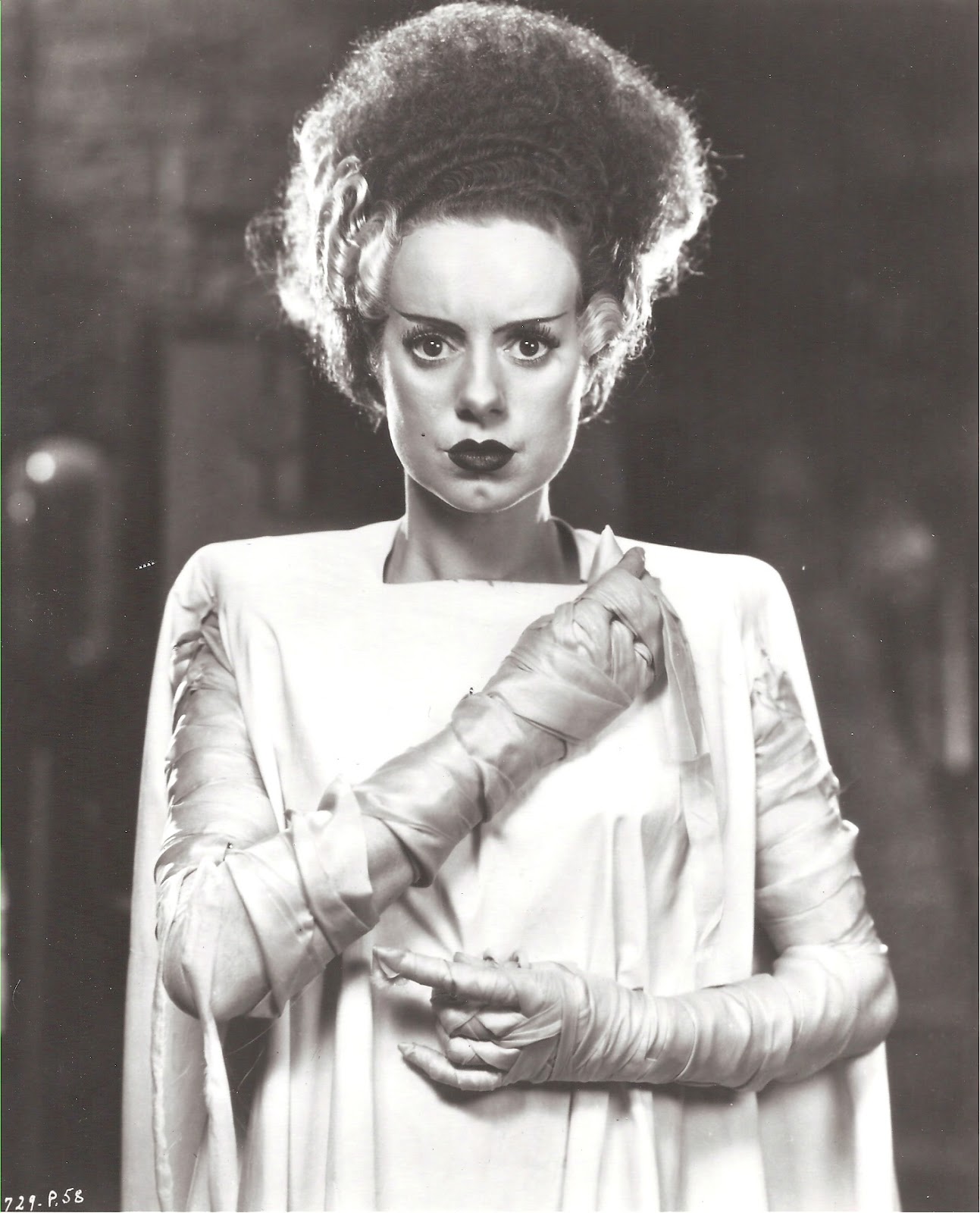
During the Laemmle era, Universal capitalized on their triumphant year by following 1931 with an active horror output in 1932-1936 before the founding family had to sell the studio due to mid-Great Depression financial crises. From 1932’s “The Mummy,” another masterpiece of slow-building terror with an unprecedented Pierce makeup and Karloff characterization, to Whale’s “The Invisible Man” introducing the striking persona of Claude Rains, to several Karloff-Lugosi pairings, the studio produced many unforgettable films at the time. Arguably the crown jewel of the mid-1930s Universal output is 1935’s “The Bride of Frankenstein,” which many consider the finest of the films in many respects. Elsa Lanchester as the named Bride created a remarkable vision of ghoulish beauty, even more impressive when considering she is only onscreen as the wordless creation a few scant minutes at the end of the film. Karloff, given the chance to speak as the Monster, offers one of his best screen performances in “Bride,” and in tandem with the first “Frankenstein” film, makes the character recognizable to most any age audience member of any era. Karloff historian Ron MacCloskey elaborated on the timeless nature of Karloff’s appearance. “The look of the Monster, with the flat head, scars and electrodes on the neck, is seen every Halloween,” said MacCloskey. “Even the movements of the Monster—stiff legs, arms outstretched—are all immediately identifiable.”


Alas, with the Laemmles out, regime change dictated a shift in philosophy at the studio in the late 1930s, and for a time, it seemed that the Universal monster film had indeed died. But audience demand necessitated a quickly-arranged sequel, and at the end of the decade, “Son of Frankenstein” debuted. Featuring Karloff in his final turn as the Monster and Lugosi, in one of his best performances as the wretch, Ygor, the third “Frankenstein” film might not have had the facility for fascinating audiences as the first two films, but it ushered in a slew of additional Universal genre films – albeit many sequels – in the early-to-mid 1940s.

Among the horde of genre films at Universal during a time of rotating studio heads, only 1941’s “The Wolf Man” featured a monster that resonated as strongly for as long a period of time as the characters in the films of the 1930s. Played to perfection by Lon Chaney Jr., the Wolf Man character was not the first lycanthrope on screen and might not have amazed audiences as significantly as the many elaborate werewolves to come, but the film and character continue to fascinate genre fans. Creature creator John Rosengrant (“Jurassic Park”) explained the longevity of the singular project. “The basic story is timeless as it parallels the storylines of the Greek tragedies,” he said. “A person is suffering by the whim of the Gods through no fault of his own.”

When Universal merged with International Pictures just after World War II ended, directions were again altered, seemingly for good, which might have relegated “House of Frankenstein” and “House of Dracula,” the two so-called “monster rallies,” as the final Universal horrors in 1944 and 1945, respectively. Yet, there was life still twitching as several characters were brought back – without Jack Pierce, Vera West, or special visual effects expert John P. Fulton – for “Abbott and Costello Meet Frankenstein” in 1948. Though that monster-comedy film was an unqualified hit, it did not spurn a return to heavy genre output at Universal-International.

Instead, the 1950s ushered in a slate of science-fiction-based films, with one last monster picture coming to fruition when it debuted in 1954. “The Creature From the Black Lagoon” was considered in as high regard as its big brothers and sisters from some 20+ years beforehand though decidedly in a modernized technological vein. However, the amphibious Gill-Man shared the tragic path of the earlier Universal monsters, and represented yet another instantly iconic visage as denoted by veteran creature designer and performer Tom Woodruff, Jr.. “There is a blankness to its expression, fitting for its primeval aquatic origins,” he said. “And there is a simplicity to the execution of the build of the suit that resonates the ‘less is more’ school of design.” When the third “Creature” film unspooled in 1958, it was widely accepted as the last breath of the Universal cycle.

Magazines such as Famous Monsters of Filmland helped keep the Universal monsters alive for new generations in the 1960s and 1970s through publishing detailed accounts of making of the films and rarely seen photographs. The films also lived on through broadcasts on syndicated television stations nationwide in a time before home video, which has now obviously brought the films and characters to a new level for contemporary fans. Veteran actor and monster collector Daniel Roebuck connected such new fans to the ones who first viewed the films in a theatrical setting. “Although not scary to the modern audiences, the pathos and tragic suffering of so many of these characters can't help but touch the viewer,” he observed.

Certainly, the Universal monsters have never truly dipped in their popularity and are still foremost among genre fans despite their notable age in a time of erstwhile short attention spans. Oscar-winning makeup artist William Corso (“Lemony Snicket’s A Series of Unfortunate Events”) summarized the effect that the films have had on numerous filmmakers working today, including not only makeup people, but visual effects artists, writers, and directors. “Universal’s stable of monsters inspired me and countless generations to enter the fields of art and film,” he said. “Not only can they be counted as some of the most iconic characters in film history, but also as significant works in the history of art, as much as any of the old masters gave us.”


In the end, audiences continually return to the Universal monsters for reasons that cannot often be easily explained. Without question, Hollywood has churned out more visceral, explicit, and even frightening films in most every decade since the originals. So why are the classic monsters a constant presence in merchandise collections, video libraries, and televised and theatrical revivals, both during Halloween season and otherwise? Fred Dekker, co-writer and director of “The Monster Squad,” the 1987 homage to the original characters, offered one provocative answer. “What's timeless to me about the Universal monsters is that on one level, they're not really monsters at all; they're outcasts,” Dekker said, “and in most cases, not by choice. Dracula has a disease, the Wolf Man an affliction. The Mummy was killed and resurrected against his will, and Frankenstein's Monster never asked to be born. The Gill-Man is out of his time. So on one level, they're these iconic boogey men who scare us—but at the same time, they appeal to that part of us that feels like an outsider, a weirdo, like someone who doesn't quite fit in. I think we relate to them on that level, even if it's subconsciously.”


Scott Essman has written extensively about Jack Pierce and the Universal Classic Monsters since 1996. He can be reached at scottessman@yahoo.com.

Wednesday, September 12

Universal Studios Art Contest

 All you artists out there who are classic monster fans, here's your chance to prove your stuff and win great Universal prizes in the process.


Read the rules carefully before entering, especially paying attention to medium, size, and subject matter. Good luck!!!


ILLUSTRATE YOUR OWN VERSION OF A UNIVERSAL STUDIOS CLASSIC MONSTER

Contest Rules

1. One artistic entry per person is allowed.

2. Participants: All amateur artists welcome. Open to U.S., Mexican, Canadian and British citizens only.  Two age groups will be considered – up to 14 years of age, and 15 years of age and up.

3. Size Requirements: All submitted Artwork entries must be created on a maximum size of 8 1/2” X 11” and must be created on a flat paper material – no three-dimensional sculptures are allowed for this contest..

4. Medium: All artwork must be created entirely by the submitting artist. All two-dimensional hand-manipulated forms for art medium are acceptable. Oils, Acrylics, Pastels, Charcoal, Water Colors, Pencils, and Crayons are acceptable.  We will not accept any Computer Design, Computer Illustration, or digitally manipulated designs. No Commercial Photo Lab work will be accepted. All Artwork must be original – but must be photographed and e-mailed per number five below.

4. Subject Matter:  An original artistic rendering of ONE of Count Dracula, Frankenstein’s Monster, The Mummy, The Invisible Man, The Bride of Frankenstein, The Phantom of the Opera, The Wolf Man, or The Creature from the Black Lagoon.  This should be the artist’s completely original conception of the character, and not based on any previous versions that have appeared in film, TV, comics, or any other artistic medium.

5. Label all artwork with your name, medium used, age, and complete address, phone number, and e-mail address and e-mail it to: universalmonsterclub2012@yahoo.com.

6. Judging:  Will be done by a jury of prominent local Hollywood makeup artists and will be held prior to the October 2, 2012 release date of the Universal Classic Monsters – The Essential Collection set.

7. Dates:  All submissions MUST be received by September 30, 2012.

8. Prizes: One Grand Prize will be awarded for each age group— each Grand Prize winner will win the complete Essential Collection set plus the Jack Pierce – Universal Monsters Bust created by Art of Clay plus a person-to-person phone call with a Hollywood monster maker.  Five runners-up for each age group for each character included will win an Essential Collection Set.

9. Display: The top entries will have their collective artwork reproduced in high quality, full-color resolution and will be available for display on the Universal Monster Club website.

10. Note: All entries together with all of the entrant’s right, title and interest in the copyright for the work, shall become the sole property of Visionary Cinema upon submission. The entrant represents that each entry is the exclusive and original work of the entrant.  Universal Studios Home Entertainment will not be responsible for displaying any artwork that does not win a prize nor be responsible for offering feedback about any and all artwork.

Tuesday, February 9

Happy birthday Lon Chaney Jr.

104 years ago a legend was born... Feb. 10 marks the birthdate of the one and only Lon Chaney Jr. Appropriate that it falls on the week that the remake of The Wolf Man hits the theaters. Lon was, until now, the only actor to ever play the part of the Universal Wolf Man... he even referred to the part as his "baby." Would have been even better if the movie premiered tonight, but perhaps somewhere someone is seeing a sneak preview of it this evening.

In honor of Lon Jr. here's a clip from an interview where he talks about his thoughts on the state of horror films at that time. Now I've read this excerpt before, but until tonight had never heard it. It was obviously done very late in his career, and you can hear the toll alcoholism had paid on him in his voice. He was only 67 when he passed away, way too young. Here's to ya, Lon!

Monday, February 1

A Match made in...well, somewhere!

Lon Chaney Jr. and Evelyn Ankers appeared together in a total of 8 movies, all for Universal Studios. The first of these to hit the screens was The Wolf Man in 1941. But the first movie they shot together was North to the Klondike, filmed earlier that year and released in 1942.
Lon and Evelyn's dislike for one another is well documented. I think they probably would have gotten along better if the Wolf Man had been shot first, but things got off on the wrong foot during Klondike. Boys will be boys, they say, and one of the other stars in this movie was Broderick Crawford; he and Lon didn't exactly bring out the best of one another. They were both heavy drinkers and putting the two of them together was asking for trouble. In addition they shared a dressing room, and one night while drinking began brawling and destroyed the room. The studio in turn reassigned this room to Evelyn Ankers, which didn't exactly endear her to the fellas.
According to Don G. Smith in his book "Lon Chaney, Jr. Horror Film Star" Crawford was offended, and later greeted Evelyn on set "...with a hearty 'Hiya Kid!' while slugging her in the arm with a good natured jab. The blow immediately cramped Anker's arm, sending her into tears. The tears, in turn, sent mascara into her eyes, creating an irritation that lasted for two days." Chaney laughed at the incendent which further angered Evelyn.

The boorish behavior and drinking naturally put off Evelyn, and who can blame her? She was trying to build a career and act like a professional. The hard feelings continued throughout their careers. At a publicity event for Universal Studios a drunken Chaney got into a near fight with Evelyn's husband, actor Richard Denning. It must have made things somewhat difficult on-set but there is no denying their on-screen chemistry.

Friday, January 29

Shave and a haircut


This promotional pic was obviously taken at the same time as the last one I posted - Lon still has that object in his hand here, whatever it is.

Thursday, January 28

When the Wolfsbane Blooms...

Wolfsbane is mentioned prominently in the poem that is recited several times in The Wolf Man;

“Even a man who is pure of heart, 
and says his prayers by night, 
may become a wolf when the wolfsbane blooms, 
and the autumn moon is bright”

 …but what is wolfsbane? I’ve always wondered if it’s a real plant, so I did a little investigation.


Wolfsbane is indeed a real variety of plant related to the buttercup. Its scientific name is Aconitum, and there are over 250 varieties of this plant. Aconitum grows primarily in the mountainous regions of the Northern hemisphere. It has dark green leaves with flowers of various colors including blue, purple, white, yellow and pink. It is better known by a variety of names including wolfsbane, monkshood, and aconite.

Aconitum is also highly poisonous. According to Wikipedia “... the sap oozing from eleven picked leaves will cause cardiac symptoms for a couple of hours.” In 2004 Canadian actor Andre Noble died during a camping trip after accidentally consuming aconite (the actual poison contained in the plant).

It has been used throughout history in everything from witch’s brews to poison arrows. Various superstitious beliefs have been attached to the plant which, according to the version you hear, have been rumored to cause, cure or kill werewolves and vampires. It is very likely that Curt Siodmak, the writer of the script, heard these legends while growing up in Germany, and decided to incorporate them, thus adding a bit of old world atmosphere to the 1941 film.

Tuesday, January 26

Werewolf nail salon


Yet another of the promotional pics Lon and Evelyn took for The Wolf Man. They seem to be getting along well here... Wonder what Lon's holding is his paw, er, hand, there?

Wednesday, January 20

A Werewolf’s Best Friend is His Dog


 Frankenstein Meets the Wolf Man (1943)

There is just something about Lon Chaney Jr. that, despite his drinking and personal problems, makes him a lovable guy. And these pictures demonstrate that beautifully.


  Frankenstein Meets the Wolf Man (1943)

I just don’t trust folks who don’t like dogs.  Dogs are honest and loyal, and always happy to see you. With a dog there's no pretensions - what you see is what you get. They are sweet, lovable, and kind companions, and honestly, I like them better than most people. And I think Lon Chaney Jr. probably felt the same way.


 Frankenstein Meets the Wolf Man (1943)

That’s Moose the dog in these pictures with Lon, taken on the set at various films. What a job, where you can take your dog to work with you! Moose was Lon’s faithful companion for a number of years, and reportedly even made screen appearances in at least two Universal horror films, The Wolf Man and Frankenstein Meets the Wolf Man. In The Wolf Man he played the wolf that bit Larry Talbot and gave him the terrible curse of Lyncanthropy.


 The Mummy'sTomb (1942)


It is obvious from looking at these stills that Lon felt a lot of love for Moose and they shared a deep connection. During the filming of The Cobra Woman in 1944 Moose was hit by a truck at the studio and killed. Not sure what age Moose was at this time,  but it was surely a sad day for Lon and quite a blow.


Below is a shot of me with two of my furry buddies, Kirby (named for comic book artist Jack Kirby) and Kelly. I unfortunately lost both of these dogs over the past year, but they, like Moose, lived happy lives. Here’s to Moose, the Shepherd, and Kelly and Kirby the Dalmatians. I miss you guys.


He has this effect on all the ladies...


A lot has been made of the problems between Lon Chaney and Evelyn Ankers. The two just did not get along all that well... which is interesting because Universal kept casting them in movies together, in a total of 8 films. After the Wolf Man Evelyn swore she'd never work with Lon again, but they made two films together the very next year, two more in 43, two more in 44, and one in 45. Their on-screen chemistry really does work, and audiences obviously loved the duo together.

Films they co-starred in:


1. The Wolf Man (1941)
2. North to the Klondike (1942)   
3. The Ghost of Frankenstein (1942)
4. Crazy House (1943)
5. Son of Dracula (1943)
6. Weird Woman (1944)
7. Follow the Boys (1944)
8. The Frozen Ghost (1945)

Monday, January 18

Beware the full moon...


Another of the studio shots of Lon and Evelyn Ankers. I wonder how many of these they did in total?

Lon and Evelyn


Another posed shot of Evelyn and wolfie. Universal was obviously proud of this makeup and the upcoming movie, and I imagine the buildup for it was pretty cool. I've been seeing lots of previews of the new Wolfman movie on TV lately, too, as Universal gets the promotional machine rolling for a wolfman movie.

Sunday, January 17

Beware the Wolf Man


This is one of a series of photos of Lon Chaney in the wolf man makeup with costar Evelyn Ankers. Great pic...

Friday, January 15

Even a Man Who is Pure of Heart...


Even a man who is pure in heart
and says his prayers by night
may become a wolf when the wolfbane blooms
and the autumn moon is bright.

Thus goes the poem repeated several times throughout the original Wolf Man movie. But where did this come from? Here is writer Curt Siodmak speaking about this very subject in an interview:

“I made that ditty up. Now people believe it is part of European Folklore…”


Curt Siodmak was born August 10, 1902 in Germany. He moved to America with his brother Robert and moved to Hollywood in 1937. They both worked in Hollywood, writing for movies and tevevision. Curt wrote screenplays for an incredible list of Science-Fiction and Horror films, including: The Invisible Man Returns, The Invisible Woman, The Ape, Black Friday, The Wolf Man, The Invisible Agent, Son of Dracula, I Walked with a Zombie, Frankenstein Meets the Wolf Man , House of Frankenstein, The Beast with Five Fingers, and many more.

Growing up in Europe gave Curt a unique perspective when it came to writing, and tapping into folklore and traditions of Europe no doubt had an influence on the fairy-tale like quality I’ve always felt The Wolf Man movie had about it. Here is Curt speaking about that very subject:

“But these stories also have a deep atavistic meaning. They appeal to our hidden basic instincts which we remember subconsciously since the time our forefathers lives in caves. Man wanted to identify himself with the strongest animal he feared. The wolf was the most dangerous animal in Europe at that time. So, there was the Tigerman in India, the Snakeman in the Pacific. The fairytales are in my opinion the fear of winter. Little Red Riding Hood is swallowed by the bad wolf-the winter-the young hunter, spring, frees her and kills the winter with its cold and hunger. Sleeping Beauty has the same theme: the bad witch-winter-poisons her. Spring, the young prince kills the witch, Sleeping Beauty coughs up the poisoned apple, comes back to life and the thorns start blooming with a million roses. Very poetic!”

Curt was an interesting man who later moved to directing. He even had a small part as an extra in Metropolis. The story goes that while working as a reporter in Germany he attempted to interview director Fritz Lang. This led to his role as an extra as a workman in that 1927 Fritz Lang classic.

Wednesday, January 13

The Wolf Man Cane


One of the key elements of the 1941 film The Wolf Man is the wolf’s-head cane that Lawrence Talbot picks up at the antique shop in town. This prop is perhaps the single most recognizable element from that film, other than the werewolf makeup (designed by Jack Pierce). That prop is still surviving and well taken care of by avid monster-kid, collector, and friend of mine, Bob Burns.


Bob came into possession of this treasure, one of the gems of his collection, when just a kid. He had a friend in school whose dad was Ellis Berman, a special-effects, makeup and prop man who had worked in several movies in Hollywood. He was also, incidentally, the very person who built the wolf’s-head cane prop from the Wolf Man film. (Ellis had two sons, Tom and Ellis Jr., both of whom worked in films in makeup and effects. I will have to ask Bob next time I talk with him which of the Ellis kids he was friends with).

Bob would often hang out with his friend at the Ellis studio, staring longingly at the wolf’s-head ornament (the wooden stick of the cane had long since been removed, only the top wolf ornament remaining). In Bob’s book “Bob’s Basement” he writes:

"I spent many, many afternoons quietly staring at it. One day (Ellis) said to me, 'You really like that thing, don't you?' Like it? I loved that cane head; it was a real, physical object that had actually been used in one of my favorite movies. 'It's yours. Go ahead and take it,' he said. I thought I would burst as I took it home to put in a place of honor. Thus began my lifelong occupation as custodian of treasures from sci-fi and monster movies."

The wolf’s-head ornament was made of cast rubber and painted silver. It features the head of a wolf in the front, and in the back, a pentagram with a wolf running inside it. The new Wolfman movie, due in theaters next month, also makes use of the element of a cane with a wolf’s head atop it, although I am not sure if it is going to be as prominent of a plot device as in the original film. But it is featured prominently in one of the many posters for the new movie… so I thought I’d place them side by side for comparison.


The new cane is changed slightly from the original design. The wolf’s head itself is similar, but more detailed and meaner looking, with longer, sharper teeth. The pentagram with the wolf inside it is gone, which is actually fine. I think the new cane looks really nice and is a very handsome design. I’m glad they’re including it in the new film, and it’ll be interesting to see if that is how Lawrence is killed in the new film. Maybe Bob Burns can get this cane as well to add to his collection beside the Ellis Burman original.

Oh, and speaking of Ellis Burman – I mentioned before briefly about his kids. Turns out the Burman family has a long history of Hollywood filmwork. Ellis Burman was born in 1902 and worked on several really fun genre films: The Wolf Man (property maker: Larry's Silver Wolf Head Cane), Teenage Cave man (dinosaur sequences), Unknown Island (special effects photographer and creator), and The Ghost of Frankenstein (makeup dept. technician). He died in 1974.

Ellis’ son Ellis Berman Jr. is an award winning makeup and special effects technician who has worked on such films and TV shows as: Prophecy, Star Trek films and TV episodes, Back to the Future II & III, The Goonies, Alien Nation, Starman, Terminator and many others.

Ellis’ son Tom Berman is also an award winning makeup and special effects technician who has worked on such films and TV shows as: The X Files, Robin Hood Men in Tights, Mask of Zorro, The Goonies, Teen Wolf, Halloween III, Prophecy, The Thing with two Heads, Howard the Duck, Cat People, Invasion of the Body Snatchers, Frogs and many others.
Ellis Jr. had a son, Ellis Berman III who has worked in sound, music and makeup in such films as: Deceit, Close encounters of the third kind (sound restoration), Night of the Demon (sound restoration), Gone with the Wind (sound restoration), Spacehunter: Adventures in the Forbidden Zone and many more.

Tom had a son named Barney Berman who has worked in makeup, special effects, and acting in such films as: Tropic Thunder, The Ring Two, Constatine, Dawn of the Dead (2004), The Haunted Mansion, Men in Black Two, Fright Night 2, Brain Dead, House and many more.

Quite the talented family and what a great list of movies they’ve worked on!!

Tuesday, January 12

Jack Pierce, makeup master

The Following is an article written by my buddy Scott Essman over at Universal - it's an article about Jack Pierce and his ground breaking werewolf makeup on The Wolf Man. Includes quotes by Jack discussing his approach. Enjoy!


THE WOLF MAN

“I don’t use masks or any appliances whatsoever,” proclaimed Jack Pierce about the development of his famous monster characters. The one exception to Pierce’s rule occurred with his striking initial realization of The Wolf Man in 1941. “The only appliances I used was the nose that looks like a wolf[‘s nose]. There you either put on a rubber nose or model the nose every day, which would have taken too long.”


The idea of Jack Pierce re-creating a wolf character from scratch every day of principal photography may seem daunting, but — as with the Frankenstein Monster and the Mummy before — Pierce prided himself on doing things from the bottom up with each new makeup application. When Lon Chaney, Jr. was cast as the title character in George Waggner’s film, Pierce resurrected the conception of a man-wolf that he had originally conceived for Boris Karloff in the early 1930s. Though Henry Hull became Pierce’s Werewolf of London in 1935, that was a scaled down version of the makeup intended for Karloff in the same role.


For the Waggner film, slated as a B-picture by the Universal brass, Pierce and special effects supervisor John P. Fulton knew that they had an opportunity to create a unique project that would harken back to the old Laemmle years at the studio. In Chaney, they had the hulking physical actor who could be used to realize their ideas. The Wolf Man appeared in two key “transformation” scenes— which would became the hallmark of the character—and in several momentous chase scenes, including the final climax in the forest.


“It took 2 1/2 hours to apply this makeup,” Pierce said, indicating the head, chest piece and hands. “I put all of the hair on a little row at a time. After the hair is on, you curl it, then singe it, burn it, to look like an animal that’s been out in the woods. It had to be done every morning.” As a result of Pierce’s methods, audiences were treated to the perfectionism in The Wolf Man.


Pierce’s other key characters in The Wolf Man included 1940s “scream queen” Evelyn Ankers as Gwen Conliffe (opposite top left), Claude Rains as Sir John Talbot (opposite top right), and Maria Ouspenskaya as Maleva, the gypsy woman (opposite bottom right). Pierce went on to create the Wolf Man character in succeeding sequels, including Frankenstein Meets the Wolf Man (1943), above and right, and both House of Frankenstein (1944) and House of Dracula (1945), below. The latter, originally titled “The Wolf Man’s Cure” featured an end to the cycle of appearances by the Wolf Man in Universal films, but the character would inexplicably reappear in Abbott and Costello Meet Frankenstein three years later. By that point, Bud Westmore was supervising makeup artists Jack Kevan (the Frankenstein Monster) and Emile LaVigne (the Wolf Man) in their execution of Jack Pierce’s original designs.

Friday, January 8

Wolf Man director George Waggoner

I’d like to pay tribute today to a man who had a huge influence on the success of the 1941 Universal classic The Wolf Man, but whose name is little known to most fans of the film. This man had a hand in one capacity or another in several of my all time favorite horror films: The Wolf Man, Man Made Monster, Frankenstein Meets the Wolf Man, even the Adam West Batman series. I’m talking about director George Waggner.


George Waggner (spelled with two g’s) was born in New York City on September 7th, 1894. He studied Pharmacy at the Philadelphia college of Pharmacy, where I have found conflicting reports about whether he graduated. His plans to become a Pharmacist were put on hold, however, when World War I broke out, and he served a stint in the military. I am not sure which branch he served in, but if I had to hazard a guess I’d say the Navy. Several of the scripts he would later write were sea stories, including his very first, Gorilla Ship a.k.a. Vengence Rides the Sea.

After the war George found himself in Hollywood where he initially worked as an actor. This makes me wonder if perhaps he met someone in the service who got him interested in this profession, or if he just somehow stumbled upon this new career. His first acting role was in a 1921 silent film called The Sheik. He appeared in 7 films between 1921-1926, several of them westerns, and even portrayed Buffalo Bill Cody in the film The Iron Horse in 1924 (directed by John Ford).


With the advent of sound in movies (the first feature film “talkie” being The Jazz Singer in 1927) George shifted his interest and began working as a song composer and lyricist for movies. He wrote lyrics and music for songs featured in 17 films between 1929 and 1949, his first being the lyrics for the songs “If I had my Way” and "I'm That Way About Baby (And She's That Way About Me)" in the film The Flying Fool from 1929.

In 1932 George again expanded his creative interests and started what would become a long and successful career as a writer. His first credit is the screenplay for Gorilla Ship in 1932. He’s credited for screenplay, dialogue or writer for 24 films between the years 1932 and 1938. With the film Western Trails (which he wrote under the pseudonym Joseph West) he began writing and directing films. In all George would write for 71 movies and TV series, including the screenplay for one of my all time favorite Universal movies, Man Made Monster (starring Lon Chaney Jr.).


In 1938 George began directing movies. He made 6 that year: Ghost Town Riders, Prairie Justice, Guilty Trails, Black Bandit, Outlaw Express, and Western Trails, all of which he also wrote. I’m not sure which of these came out first, but did read somewhere it was Black Bandit, a western starring Bob Baker the singing cowboy. George would go on to direct 58 films and TV series, including several that are quite significant to the horror genre. In 1941 he directed Horror Island, Man Made Monster, and his best known picture The Wolf Man (what a year!). He directed multiple episodes of The Veil for television in 1958. Between 1966-1967 he directed one episode of The Green Hornet, seven episodes of The Man from U.N.C.L.E. and ten episodes of Batman.


Beginning in 1941 George even worked as a producer in Hollywood, racking up 17 producer credits in all including such notable films as: The Wolf Man, Ghost of Frankenstein, Invisible Agent, Frankenstein Meets the Wolf Man, and The Phantom of the Opera (1943 version starring Claude Rains). His last producer credit is listed as The Wolfman, an eight minute abridgment of the 1941 feature The Wolf Man, released in 16mm film format (which he also directed).

George was a multi-talented man who had a long Hollywood career. His wife’s name was Danny Shannon, and they had a daughter named Shy Waggner who even had a small role at age 25 in The Fighting Kentuckian, a John Wayne film written and directed by George. He passed away on December 11th, 1984 in Hollywood of natural causes at age 90. Here’s a salute to this multi-talented and little recognized talent of the silver screen.

Thursday, January 7

WOLF MEN : The Men Who Created 1941’s THE WOLF MAN

Over the next few weeks I'll be looking at the Wolf Man film, Lon Chaney Jr., and Jack Pierce. To kick off the month long celebration, below is an article by Universal employee and major Monster-kid Scott Essman. Scott has worked hard to keep classic monsters alive and well, and this is just one of many such articles he's written on all the creatures we know and love. Enjoy!


WOLF MEN : The Men Who Created 1941’s THE WOLF MAN

by Scott Essman

The long-awaited release of Universal Studios’ 2010 version of The Wolfman conjures the history of the men who made the original horror films at the studio in the 1920s through the 1940s. Not only was the original 1941 film The Wolf Man key among them, but the rich history of the other films is directly tied into both why and how that film was created.

In 1928, after his father had appointed 21-year-old Carl Laemmle, Jr. as head of production at Universal Studios, the machinery was in place for a new wave of films based on classic horror stories. By 1931, the studio had both Dracula and Frankenstein as two of its greatest successes, and they followed those up with a few more early 1930s originals, including The Mummy and The Invisible Man.

By 1935, they had produced Werewolf of London, their first film based on the Loup-Garou stories from France of men who turned into wolves at the turning of a full moon. When the Laemmles left the studio in 1937, Universal seemed doomed to a slate of poorly produced sequels to the great films of the Laemmle era as quickly churned out sequels to Dracula, Frankenstein, and The Mummy arrived in droves. However, there was one exception to the rule which arrived in 1941 which would set a new standard and ultimately be ranked with the greatest of the Universal horror classics.

As the 1940s began, horror movies were beginning to take a back seat to sweeping romantic dramas and comedies. But one intended B picture was the landmark The Wolf Man, reestablishing the horror genre at Universal. The film was originally meant for Boris Karloff some ten years earlier, but by 1941, when Karloff had moved onto mad scientists and other older characters, a new actor was positioned as the new Karloff at the studio. His name was Lon Chaney, Jr. Until the late 1930s, the younger Chaney had been less heralded than his silent movie superstar father, but his appearance in 1939’s adaptation of Of Mice and Men put him on the cinematic map. Chaney, Jr. was a star in the making and Universal snapped him up for a run of horror films that lasted throughout the 1940s. With Jack Pierce’s innovative makeup - a more thorough lycanthrope overhaul of Chaney Jr.’s face than had been utilized on Henry Hull in Werewolf of London - The Wolf Man was a remarkable horror movie character and equally as memorable as Karloff’s Frankenstein Monster and Mummy and Bela Lugosi’s Dracula.

In addition to the team of Jack Pierce, director George Waggner, and visual effects wizard John P. Fulton, the craftsmanship of The Wolf Man was also entrusted to editor Ted J. Kent, A.C.E . Of all the monster movie editors, none was more prolific than Kent, an in-house editor at Universal for over a quarter century. Kent's monster tenure spanned no fewer than five ownership changes at the studio. Though research dictates no clear reason for the change, Universal assigned Kent to James Whale's follow-up to The Old Dark House, which had been competently edited by Clarence Kolster and was released only a year after Frankenstein. This film, released in 1933, The Invisible Man, would prove among Whale’s most challenging films, with equal contributions by Kent and Fulton. No doubt, both Universal and Whale were enamored with Kent's work, and he cut three of Whale's last several films with Universal, including Show Boat in 1936 and The Road Back in 1937. But the one film that elevated Whale's reputation beyond that which his earlier films offered him was a picture he didn't even want to make.

By 1935, the idea of The Bride of Frankenstein didn't appeal to the man who was wary of being labeled a horror director. Nonetheless, many consider Whale's long-overdue sequel to be superior to the original Frankenstein with its mixture of unforgettable sequences, demonic characters, and wistful comedy. In a likely homage to Clarence Kolster's work on that first film, Kent cut Bride in similar fashion, most notably in the reveal of Elsa Lanchester's hideous title character in the final scenes; we see her in the same three matching closeups that Kolster implemented so effectively to show us Karloff's monster in the original film. Even after Whale and the Laemmles departed Universal, Kent was recruited by studio brass to cut 1939's final sequel with Karloff as the monster, Son of Frankenstein, featuring a towering performance by Bela Lugosi as Ygor that Kent surely played up in the editing room. He even cut Vincent Price's 1938 debut film, Service de Luxe! But though he likely didn't realize it then, Kent's Universal career was just starting to peak.

For the Waggner Wolf Man film, slated as a B-picture by the Universal brass, Pierce and Fulton knew that they had an opportunity to create a unique project that would harken back to the old Laemmle years at the studio. In Chaney, they had the hulking physical actor who could be used to realize their ideas. With The Wolf Man, Kent, along with major contributions by studio mainstays Pierce and Fulton, created the film's showpiece "transformation" sequences which became standard fare in the many spin-offs that followed. Witness the lap dissolves that Kent and Fulton implemented for transformations from man to wolf, and especially, in the film’s tragic climax, from wolf back to man. Kent also cleverly orchestrated the noted end of the film where Claude Rains unknowingly beats his own son with a silver-tipped cane, later realizing that it was his own flesh that he killed. In their tussle, an especially marked cut to a close shot of Chaney, Jr. as the Wolf Man struggling with Rains makes for one of the film’s most fascinating moments.

During pre-production of The Wolf Man, Jack Pierce worked diligently to create the makeup for the title character, having been disappointed with his reduced makeup for Henry Hull in Werewolf of London. Pierce pulled out all the stops for The Wolf Man with Lon Chaney, Jr. in the title role. Though the two did not reportedly get along--Chaney did not like wearing the makeup or undergoing the lengthy application and removal period--Pierce excelled again with his werewolf concept, utilizing a design he had created for Boris Karloff a decade earlier when the Laemmles were planning a werewolf film. Thus, even though it was originally intended as a B movie, The Wolf Man was a true horror classic, and Pierce's version of the character has been the model for the numerous werewolves that have since come to the screen.

The idea of Jack Pierce re-creating a wolf character from scratch every day of principal photography may seem daunting, but — as with the Frankenstein Monster and the Mummy before — Pierce prided himself on doing things from the bottom up with each new makeup application. “I don’t use masks or any appliances whatsoever,” proclaimed Jack Pierce about the development of his famous monster characters. The one exception to Pierce’s rule occurred with his striking initial realization of The Wolf Man in 1941. “The only appliances I used was the nose that looks like a wolf[‘s nose]. There you either put on a rubber nose or model the nose every day, which would have taken too long. It took 2 1/2 hours to apply this makeup,” Pierce said, indicating the head, chest piece and hands. “I put all of the hair on a little row at a time. After the hair is on, you curl it, then singe it, burn it, to look like an animal that’s been out in the woods. It had to be done every morning.” Pierce’s other key characters in The Wolf Man included 1940s “scream queen” Evelyn Ankers as Gwen Conliffe, Claude Rains as Sir John Talbot, Béla Lugosi as Béla the gypsy, and Maria Ouspenskaya as Maleva, the gypsy woman. As a result of Pierce’s methods, audiences were treated to the perfectionism in The Wolf Man.

Alas, what might have been was never realized with the stunning originality and critical and commercial success of The Wolf Man. As the U.S. entered WWII, a slew of sequels and remakes of the original horror films were cranked out at Universal with few standouts as momentous as their antecedents. Pierce went on to create the Wolf Man character in succeeding sequels, including Frankenstein Meets the Wolf Man (1943), and both House of Frankenstein (1944) and House of Dracula (1945). The latter, originally titled “The Wolf Man’s Cure” featured an end to the cycle of appearances by the Wolf Man in Universal films, but the character would inexplicably re-appear in Abbott and Costello Meet Frankenstein three years later. By that point, Bud Westmore was supervising makeup artists Jack Kevan (the Frankenstein Monster) and Emile LaVigne (the Wolf Man) in their execution of Jack Pierce’s original designs. The classic monster movie era, in effect, was over.

Upon the occasion of Jack Pierce’s death in 1968 and Ted Kent’s death in 1986, the last of the monster makers were gone, but their work continues to live on again and again, as new audiences begin to discover their treasured films. Perhaps with the fresh perspective now available to audiences with Universal's recent re-release of many of the classic horror films on DVD, including a new Legacy Collection of The Wolf Man (1941) due on DVD from Universal Studios Home Entertainment in winter, 2010, the talented craftspeople who realized these films will ultimately be recognized for their singular efforts. Alongside the collection of actors, directors and executives responsible for Universal's great horror collection, editors including Kent deserve due credit for bringing the original monsters and their movies to life.

Wednesday, January 6

The Wolfman vs. The Wolf Man

The new upcoming Wolfman movie got me thinking about the casting for the new film. I put together a few pics comparing the actors playing the main roles.

Lawrence Talbot:
In the role of the tortured soul Lawrence we have Benecio Del Toro playing the part made famous by Lon Chaney Jr. I'm really happy about this choice, as Del Toro has a bit of that rugged athletic quality that Lon shared.


The Wolfman vs. the Wolf Man - note the movies spell the title creature differently. Wonder if they did that just to differentiate them more easily? It is a remake, after all - the one word change doesn't really matter all that much, just is interesting. At any rate the new test shots of the makeup for the wolfman certainly look amazing. They enlisted Rick Baker to do this design, and wow - it totally knocked my socks off. Hopefully the computer effects will be minimal, and they'll rely on makeup more - and the wolfman won't change clothes this time around when he transforms!


Gwen Conliffe - in the role of Lawrence's love interest we have Emily Blunt playing the Evelyn Ankers role. Emily is gorgeous and sexy, but doesn't really resemble Evelyn too much. But that isn't really necessary for this part, and I think she'll do great in the role.


In the role of John Talbot, Lawrence's father, we have Anthony Hopkins in the Claude Rains role. You need an actor of considerable range to fill these shoes, and you don't get much better than Anthony Hopkins.


 Maleva the Gypsy, originally played by Maria Ouspenskaya, is played this time around by Geraldine Chaplin. I don't know too much about her, but according to IMDB she's been in over a hundred movies, mostly foreign. She most likely has the accent that the role requires, and certainly looks the part.


And lastly, in the role of the Inspector Abberline we have Hugo Weaving. Now, this isn't a straight replay of a former character. Best I can tell the new film takes the role of  Colonel Montford, played by Ralph Bellamy (Twiddle, take a note!), and splits it into two characters - Colonel Montford and Inspector Abberline. Montford was the one investigating these murders before, if I'm not mistaken, but this time around we have an inspector to do the investigation. I really like Hugo as an actor, and he'll lend a quirky air to the role.


All in all an amazing bit of casting. I am very much looking forward to this movie, as well as the new dvd release of The Wolf Man! Here's hoping they both live up to expectations!

Tuesday, January 5

Universal Legacy Series - The Wolf Man


Universal Studios is releasing an all new version of  the 1941 classic THE WOLF MAN in early February - it is the Universal Legacy Series Special Edition, a 2 disc deluxe treatment packed with extras. Included are:

Commentary by film historian Tom Weaver

Featurettes:
  • The Wolf Man: From Ancient Curse to Modern Myth,
  • Pure in Heart: The Life and Legacy of Lon Chaney Jr,
  • He Who Made Monsters: The Life and Art of Jack Pierce,
  • Monsters by Moonlight
  • The Wolf Man Archives
  • Universal Horror documentary narrated by Kenneth Branagh 
I am really, really looking forward to both this dvd and the new Wolfman movie. Definitely a howling good start to the 2010 movie season!!

Monday, January 4

The Wolfman


As many of you know, Universal pictures is releasing a new version of The Wolfman to theaters this coming Feb. It stars Benicio Del Toro in the Lon Chaney role as the tortured Lawrence Talbot; Emily Blunt as his love interest Gwen Conliffe, originally played by Evelyn Ankers; and Anthony Hopkins in the Claude Rains role of Lawrence's father, Talbot Sr. Quite the cast, indeed. This promises to be a howling good way to start the 2010 movie season. Release date is February 12th, 2010.

owwwwooooooo!